Modeling San Francisco’s District 10: How Asymmetric Capital, Ballot Heuristics, and Protest Coalitions Shook Ranked-Choice Voting
The Big Picture: In San Francisco’s District 10 supervisorial contest, an asymmetric financial blitz, moderate party consolidation, and down-ballot behavioral economics decisively overwhelmed progressive resistance.
Frontrunner Theo Ellington captured 48.67% of first-choice ballots, ultimately rolling to victory in Round 9 with 66.87%. Challengers Dionjay “DJ” Brookter and J.R. Eppler campaigned on the shared populist battle cry that “D10 can’t be bought,” but their coordinated messaging failed to overcome a classic game-theory coordination trap.
At the same time, beneath the six-figure air war sat a fractured ~23% protest and anti-establishment vote—raising the central behavioral question: was this an ideological feminist / “Fuck The Patriarchy” backlash, or an eclectic anti-machine revolt?
The Empirical Scoreboard
The opening round told the entire mathematical story long before the RCV software completed its multi-stage tabulation pass:
Theo Ellington led Round 1 with 5,132 votes (48.67%) and finished Round 9 with 6,385 votes (66.87%). Dionjay Brookter followed in second with 1,629 first-round votes (15.45%) and finished Round 9 with 3,163 votes (33.13%). J.R. Eppler captured 1,372 first-round votes (13.01%) before being eliminated in Round 8. Jessica Pessecow took fourth place on Round 1 with 768 votes (7.28%) before exiting in Round 7. Mike Trouble Lin secured 541 first-round votes (5.13%), surviving until Round 6. Minor contenders Deandra Bryant (383 votes, 3.63%), Ellsworth “Ell” Jennison Jr. (246 votes, 2.33%), Shawn M. Richard (187 votes, 1.77%), Jamo Muhammad (157 votes, 1.49%), and Pearci “PJ” Bastiany III (129 votes, 1.22%) rounded out the bottom tier.
1. Capital Saturation: Moving the Probability Baseline
In political forecasting models, money exhibits severe diminishing marginal returns in national, high-information races. In a localized, low-information municipal supervisor district, however, cash works linearly: it buys direct name recognition, saturates physical mailboxes, and establishes an immovable first-round floor.
Ellington raised $495,000 and spent $289,000 through his official campaign committee. But the decisive variable was Ripple co-founder Chris Larsen dropping an unprecedented $540,000 into an independent expenditure PAC ($500,000 in early September, followed by a $40,000 injection in late September).
Across roughly 10,500 total valid ballots cast in the district, the combined Ellington ecosystem spent roughly $80 per registered voter. When paired with personal canvassing from Mayor Daniel Lurie, endorsements from Garry Tan and GrowSF, and the official San Francisco Democratic County Central Committee nod, Ellington achieved near-total message penetration. In Bayesian terms, this prior was so strong that no down-ballot event could realistically shift the win probability below 90%.
2. The Progressive Prisoner’s Dilemma
Brookter and Eppler attempted to counter Ellington’s air war by framing the election around local resistance to outside billionaires under the slogan “D10 can’t be bought.” However, their strategic execution fell into a standard multi-candidate coordination failure:
Outgoing Supervisor Shamann Walton endorsed Brookter, while former Mayor Art Agnos and the League of Pissed Off Voters issued a dual endorsement splitting support between Brookter and Eppler. In theory, ranked-choice voting allows ideological allies to run complementary campaigns and pool transfer votes. In practice, splitting the progressive first-choice vote between Brookter (15.45%) and Eppler (13.01%) left both stranded more than 33 percentage points behind Ellington on the opening count.
Because Ellington started at 48.67%, he only needed to capture a tiny fraction of secondary preferences to cross the 50% finish line. By Round 4, before any major progressive transfers could even unlock, exhausted ballots and minor candidate transfers already pushed Ellington above 50.11% of active continuing votes. The “D10 can’t be bought” coalition needed a unified, single candidate to consolidate early momentum; splitting their resources made Ellington’s victory a statistical certainty before elimination transfers even began.
3. Ballot Economics: Mandarin Transliterations and Title Heuristics
In District 10, Chinese-American voters in Visitacion Valley and the Portola represent an essential, high-turnout bloc. In low-information municipal elections, the official ballot acts as the primary marketing document, and candidates’ Mandarin names and occupational designations functioned as crucial cognitive shortcuts:
Theo Ellington ran as 艾霖敦 (Ài Líndūn) under the designation “Public Policy Director”. The characters combine an ancient, dignified surname (艾) with “timely rain/blessing” (霖) and “steadfast/honest” (敦). This formulation read as a traditional, high-status Chinese name rather than a clumsy phonetic Western transcription. Coupled with an institutional title signaling bureaucratic competence, Ellington minimized cultural friction and protected his moderate flank in Asian-majority precincts.
Mike Trouble Lin appeared as 林育仁 (Lín Yùrén), listed as “Small Business Consultant”. Meaning “Cultivating Benevolence,” this was an authentic classical Confucian name using his genuine surname (林) alongside core Confucian virtues (育仁). For non-English-speaking voters scanning the list, this provided an organic, culturally familiar anchor that far outperformed his paid outreach.
DJ Brookter ran as 迪昂傑·(DJ)·布魯克特 (Dí’ángjié · DJ · Bùlǔkètè). This nine-character phonetic mouthful offered no cultural resonance, forcing him to rely strictly on non-Chinese organizational ground games. J.R. Eppler ran as J.R.·埃普勒 (J.R. · Āipǔlè). While his name was a standard phonetic translation, his title—”Small Business Attorney” (小型企業律師)—provided a high-trust professional signal along neighborhood commercial corridors.
The lower tier reflected steep penalties for weak designations. Pearci “PJ” Bastiany III ran with a sprawling 14-character name (畢/皮爾斯·「PJ」·巴斯蒂亞尼三世) and the title “MPA Graduate Student” (公共行政碩士研究生), finishing dead last at 1.22%. Shawn M. Richard listed “None” (無) for his designation and pulled just 1.77%, while Jamo Muhammad listed “Father” (父親) and received 1.49%. Voters systematically use professional ballot titles to weed out non-traditional candidacies.
4. Anatomy of the Protest Vote: “Fuck The Patriarchy” vs. Diffuse Anti-Establishment
Roughly 22.87% of Round 1 voters rejected the top three institutional candidates entirely. A common progressive framing asks: did this represent an intentional feminist / “Fuck The Patriarchy” revolt against a male-dominated, billionaire-funded contest?
The quantitative transfer data and precinct demographics paint a far more fragmented picture:
The Gender Signal (Pessecow & Bryant): Out of ten candidates, only two were women: Jessica Pessecow (7.28%) and Deandra Bryant (3.63%). Together, they commanded 10.91% of first-choice ballots. In high-turnout, progressive-feminist enclaves (like northern Potrero Hill), backing an unbought female nurse or housing advocate was indeed an explicit repudiation of the male political establishment and the tech-billionaire funding apparatus. When Bryant was eliminated in Round 5, her transfers broke heavily toward remaining non-establishment candidates rather than consolidating around the frontrunner.
The Populist / Nihilist Protest (Mike Trouble Lin): Lin’s 5.13% (541 votes) represented an anti-establishment revolt, but culturally distinct from a feminist critique. With the legal middle name “Trouble” and an earned-media profile in the Potrero View celebrating disruptive independence, Lin absorbed the “throw-a-brick-through-City-Hall’s-window” vote. It was an anti-machine, anti-bureaucracy protest, heavily concentrated among merchant and working-class voters who rejected the entire political class.
The Working-Class Institutional Signal (Ell Jennison): Jennison’s 2.33% had nothing to do with smashing the patriarchy—it was a pure labor signal. “Union Carpenter” acts as a demographic heuristic for working-class tradespeople who refused to back technocrats, non-profit organizers, or downtown-backed candidates.
The Verdict on Protest Mindsets: Rather than a monolithic “Fuck The Patriarchy” bloc, the protest vote was a bifurcated coalition: about half (Pessecow + Bryant, ~11%) fit an anti-oligarchic, feminist-aligned counter-vote, while the other half (Lin + Jennison + Muhammad, ~10%) was an eclectic blend of anti-establishment humor, working-class labor identity, and generalized civic frustration.
5. Capital Efficiency and The Zero-Dollar Anomalies
The most intriguing data points in the race sit on the extreme ends of campaign efficiency:
Mike Trouble Lin—whose legal middle name is indeed “Trouble”—spent a total of $397. Despite formally suspending his campaign on October 30, four days before the election, he captured 541 first-round votes (5.13%) and survived until Round 6. Lin’s cost per vote was roughly $0.73, compared to $56.31 per direct vote for Ellington (over $150 factoring in the Larsen PAC), $107.42 for Brookter, and $115.16 for Eppler. Lin leveraged earned media—most notably a dedicated profile in the Potrero View (“Here Comes Trouble”, print circulation ~12,000)—and capitalized on his authentic Chinese name and outsider branding to beat four active campaigns.
Jessica Pessecow finished in fourth place with 768 first-choice votes (7.28%) on essentially zero expenditures. Her performance was driven by two structural advantages: Position #1 on the ballot (Row 1, Column 1) and the designation “Nurse / Legal Representative”. In academic literature, the “primacy effect” routinely awards a 2% to 4% unearned windfall to the top ballot slot from uncommitted or fatigued voters. Coupled with “Nurse” (護士)—the single most trusted occupation in American public polling—Pessecow became the default low-information selection in affluent, high-turnout pockets like Potrero Hill.
Similarly, Ellsworth “Ell” Jennison Jr., a white union carpenter running no active campaign, won 246 votes (2.33%). His advantages were purely structural: Position #2 directly below Pessecow and the title “Union Carpenter” (工會木匠). In a city with deep organized labor density, that title locked in a demographic baseline without requiring a single piece of paid campaign collateral.
6. Counterfactual Modeling: Did Field Size Change the Winner?
A common post-election hypothesis argues that the crowded 10-candidate slate in District 10 diluted the progressive vote and handed Ellington the seat. A quantitative look at candidate crowding and transfer mechanics suggests otherwise:
If the race had been restricted to a three-way contest among Ellington, Brookter, and Eppler—removing the bottom seven candidates who together held 22.87% of Round 1 ballots—Ellington’s first-round share would have landed between 52% and 54.5%. Pessecow’s 7.28% base in Potrero Hill leaned moderate and demographically aligned with Ellington, while Lin’s 5.13% represented an anti-establishment merchant vote that favored small business titles over progressive community organizers. A leaner field would not have forced a tighter runoff; it would have pushed Ellington across the 50% majority threshold on the very first pass, eliminating ranked-choice counting altogether. Candidate crowding actually depressed Ellington’s initial margin below 50% rather than enabling his victory.
In a direct two-candidate matchup between Ellington and a single progressive challenger, the Round 9 head-to-head between Ellington and Brookter finished 66.87% to 33.13%. Even after factoring in exhausted ballots from voters who only ranked minor candidates, the moderate-to-progressive preference distribution in District 10 settled at roughly two-to-one.
Raising signature or fee thresholds to limit ballot access would have eliminated ghost candidacies, reduced voter fatigue, and trimmed the count from nine rounds down to one or two. However, higher barriers to entry disproportionately screen out low-budget protest candidacies while further insulating well-funded institutional frontrunners.
When an organized political machine pairs an optimized ballot profile with near-total district advertising saturation, cognitive heuristics can produce remarkable efficiency on the low end, but institutional capital dictates the baseline. The election was functionally decided the moment Ellington unified the mayoral apparatus, the PAC funding, and the moderate establishment into a single lane.
7. The Forensic Specimens
To understand how District 10 unfolded, one has to move past campaign talking points and examine the raw artifacts of the election itself: the physical ballot grid and the round-by-round elimination cascade published by the San Francisco Department of Elections. These two documents reveal how ballot mechanics, cognitive shortcuts, and ranked-choice tabulation interacted in real time.
Specimen 1: The Official 10-Column Ranked-Choice Ballot
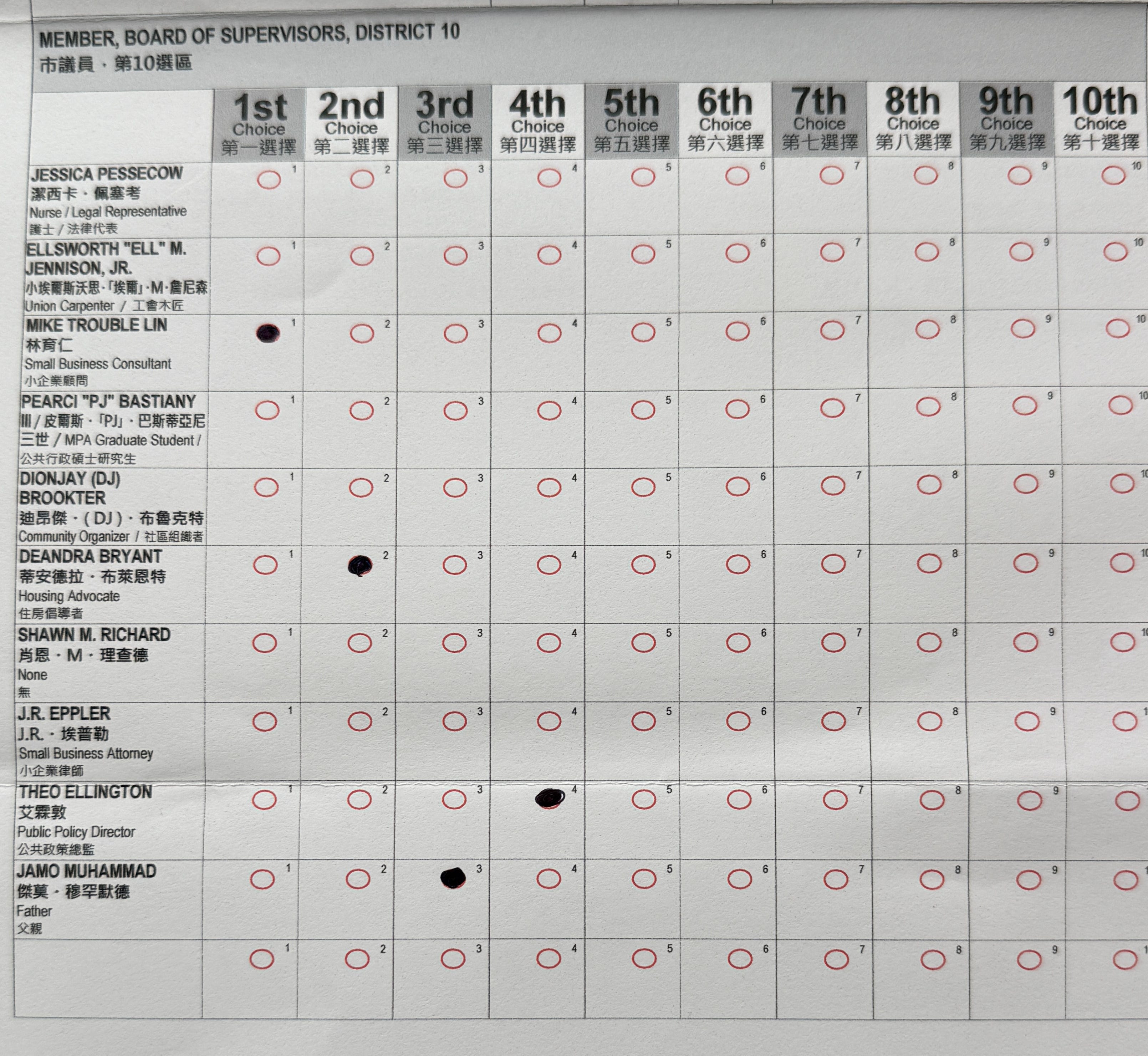
Mike Trouble Lin’s filled out ballot
The official ballot confronted voters with a sprawling 10-candidate, 10-choice matrix. Under low-information conditions, this layout forced voters to navigate several structural filters:
Primacy Bias at Position #1: Jessica Pessecow occupied the top-left slot on the grid, paired with the universal-trust designation “Nurse / Legal Representative” (護士 / 法律代表).
Occupational Legitimacy: Immediately below her, Ellsworth “Ell” Jennison Jr. presented the recognizable “Union Carpenter” (工會木匠) label, establishing a baseline among trade union households without active campaigning.
Linguistic Architecture in the Chinese Transliterations: For Cantonese- and Mandarin-speaking voters, the naming choices were stark. Theo Ellington adopted 艾霖敦 (Ài Líndūn)—a traditional, auspicious three-character name evoking blessings and steadfast honesty—alongside “Public Policy Director”. Mike Trouble Lin ran as 林育仁 (Lín Yùrén), an authentic Confucian given name meaning “Cultivating Benevolence,” paired with “Small Business Consultant”. In contrast, candidates with sprawling 9- to 14-character phonetic transliterations (like DJ Brookter’s 迪昂傑·(DJ)·布魯克特 or Pearci Bastiany’s 畢/皮爾斯·「PJ」·巴斯蒂亞尼三世) offered zero organic cultural shorthand.
Specimen 2: The RCV Round-by-Round Elimination Cascade
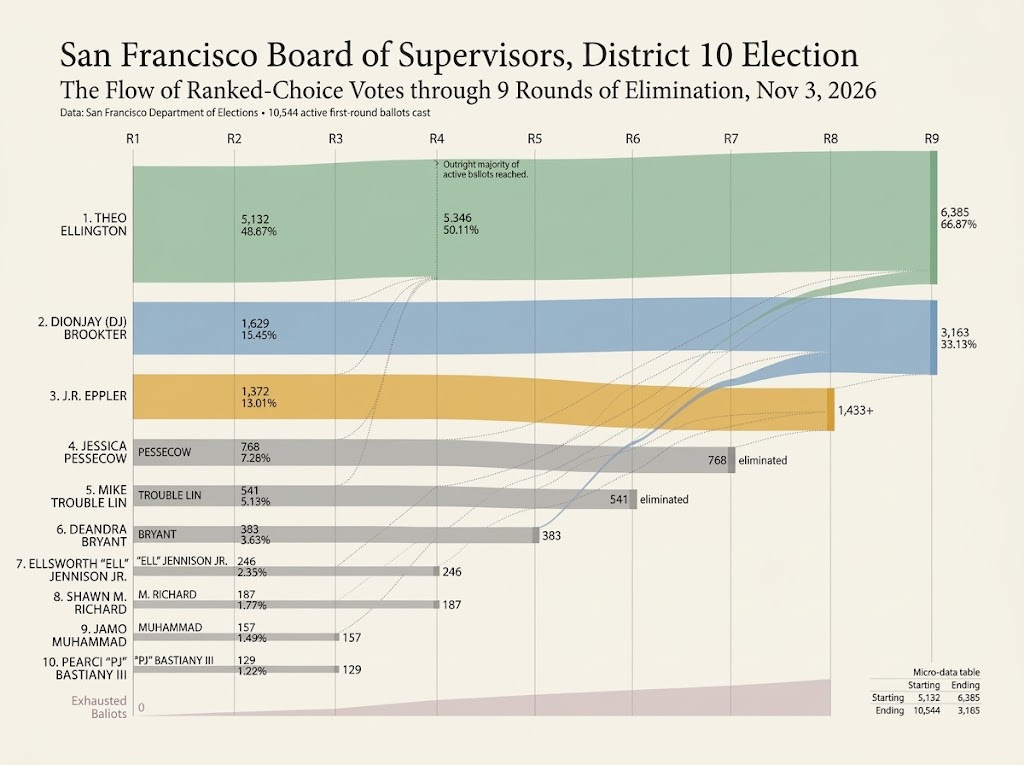
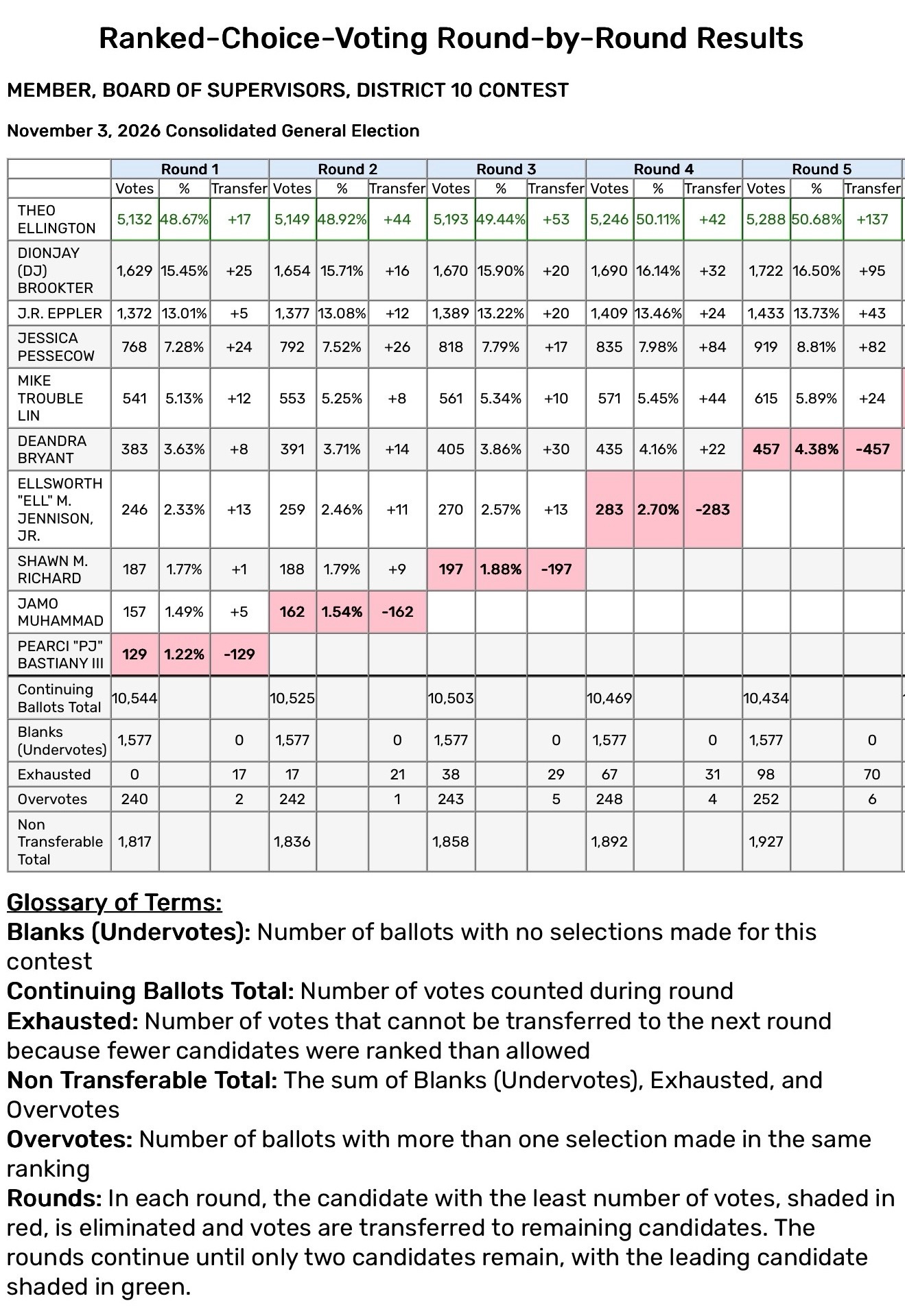
The preliminary tabulation from the San Francisco Department of Elections tracks how votes shifted across nine rounds of eliminations:
The Opening Majority Baseline: Theo Ellington opened Round 1 with 5,132 votes (48.67%). Because of exhausted ballots and minor candidate transfers, Ellington effectively crossed the 50% majority threshold of continuing active ballots by Round 4 (5,246 votes, 50.11%)—long before the major progressive contenders were eliminated.
The Progressive Split: DJ Brookter (1,629 votes, 15.45%) and J.R. Eppler (1,372 votes, 13.01%) fractured the left-of-center vote share in Round 1. With both stranded more than 33 percentage points behind Ellington on the opening pass, the progressive coordination trap was locked in from the start.
The Low-Dollar Outliers: Mike Trouble Lin held 541 first-choice votes (5.13%) and survived all the way through Round 5 to exit in Round 6. Jessica Pessecow’s 768 votes (7.28%) carried her through Round 7.
The Final Head-to-Head: By Round 9, with eight challengers eliminated, Ellington finished with 6,385 votes (66.87%) against Brookter’s 3,163 votes (33.13%), reflecting a two-to-one preference distribution across the district.
Specimen 3: The Campaign Finance Audit
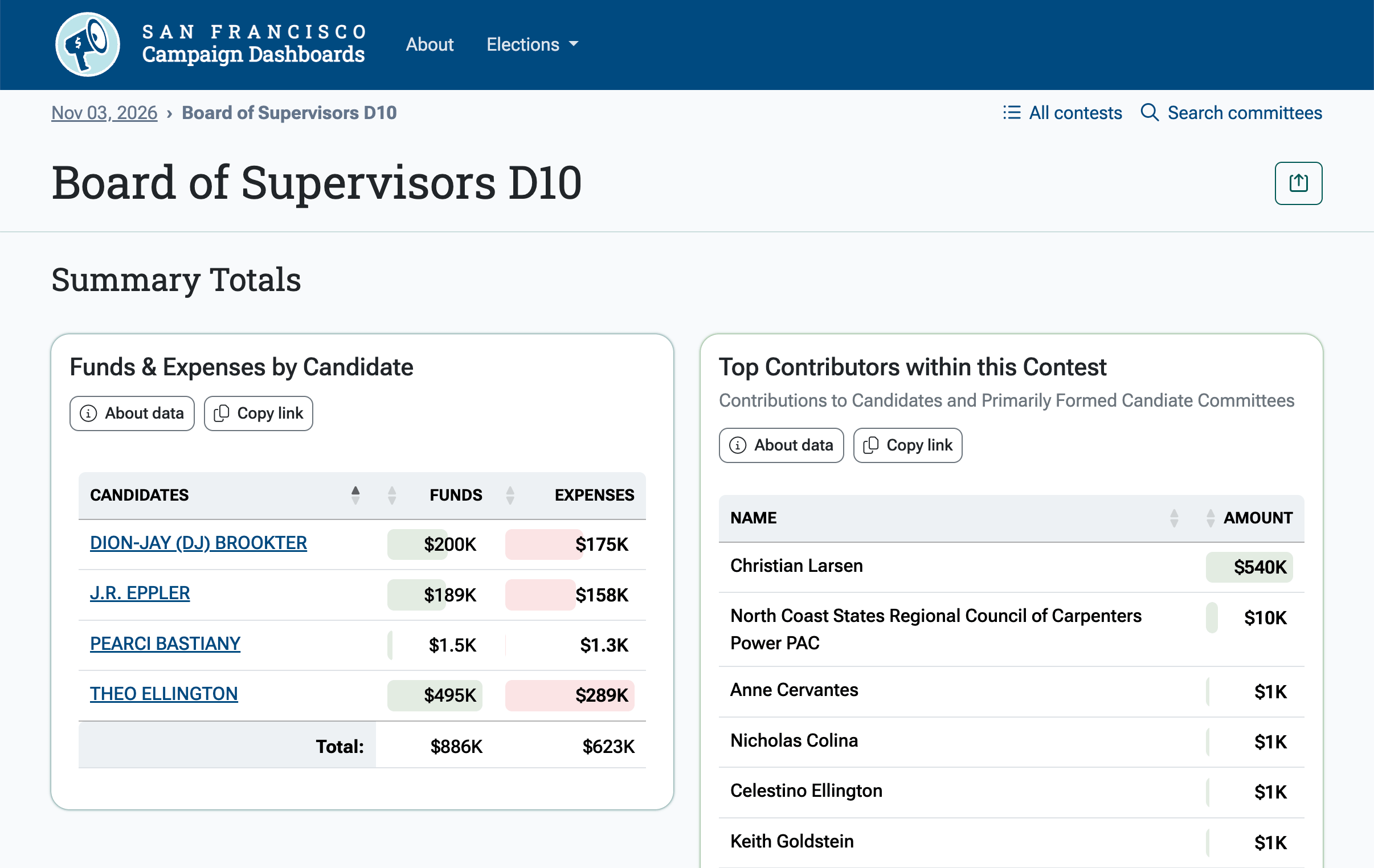
For all the talk of local values and grass-roots momentum, the final piece of evidence must be pulled from the money trails. The financial records for District 10 expose an election driven by two completely different economic ecosystems: the tightly focused “air war” and the grassroots guerrilla operation.
CANDIDATE                FUNDS        EXPENSES
Theo Ellington           $495,000     $289,000
Dion-Jay (DJ) Brookter   $200,000     $175,000
J.R. Eppler              $189,000     $158,000
Pearci Bastiany          $1,500       $1,300
(Data: San Francisco Campaign Dashboards - Nov 03, 2026)
Funds & Expenses by Candidate
The candidate ledger reveals the financial gulf between the frontrunner and the rest of the field:
The Saturated War Chest: Theo Ellington was backed by $495K in campaign funds—which is more than the funds raised by his next three competitors combined. He spent $289K out of his official candidate account, almost matching the combined spending of Eppler and Brookter.
The “Bought vs. Built” Divide: DJ Brookter ($200K funds) and J.R. Eppler ($189K funds) ran highly active, fully resourced campaigns, spending roughly ~$107 and ~$115 per 1st-round vote, respectively. Compared to a high-density, centralized campaign, these budgets required heavy boots on the ground for a return that struggled to hit 15% on the first ballot.
The High-Efficiency Shadow: By contrast, candidates like Pearci Bastiany, who operated on a mere $1,500, could scarcely print a round of flyers, underscoring the high barrier to entry for any outsider trying to penetrate the airwaves.
Top Contributors within the Contest
CONTRIBUTOR                                                 AMOUNT
Christian Larsen                                            $540K
North Coast States Regional Council of Carpenters Power PAC  $10K
Anne Cervantes                                              $1K
Nicholas Colina                                             $1K
Celestino Ellington                                         $1K
Keith Goldstein                                             $1K
(Data: San Francisco Campaign Dashboards)
The contributor dashboard highlights exactly how top-down money reshaped the contest, and it points to a heavily concentrated intervention:
The Overwhelming Whale: Cryptocurrency billionaire Christian Larsen single-handedly injected $540,000, dwarfing all other contributors. To put this in perspective, Larsen’s drop into the race was larger than the total candidate funds raised by Ellington’s three main rivals combined. Larsen’s contributions were funneled into an independent PAC supporting Ellington, bypassing standard $500 candidate limits and effectively drowning out any grassroots resistance with a tsunami of digital and mailbox saturation.
Institutional vs. Grassroots: Below the $540K outlier sits a massive drop-off: the next-largest contributor, a regional union power PAC, gave $10K, followed by private individuals like Anne Cervantes and Nicholas Colina at $1K. In a municipal race, this reflects a striking imbalance—one wealthy booster wielding more financial influence than several thousand local D10 residents combined.
8. The Equalizer with a Cap: Public Financing in District 10
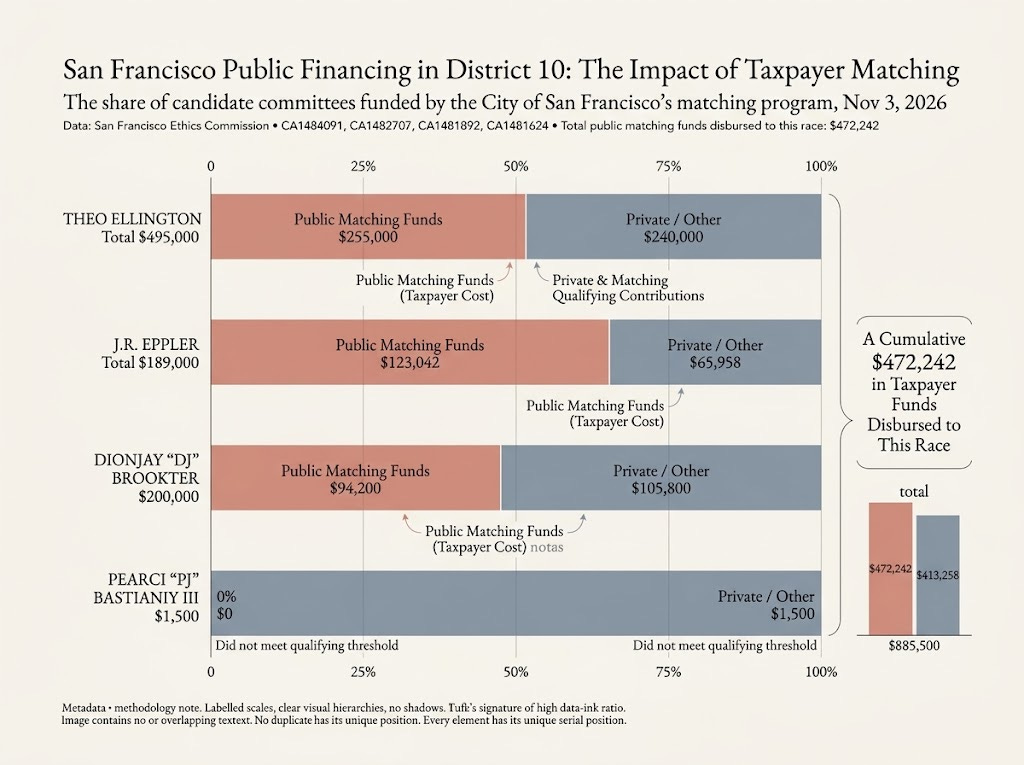
San Francisco’s Public Financing Program is designed to give grassroots campaigns a fighting chance against deep-pocketed interests by matching small-dollar local donations with municipal matching funds.
Under the city’s campaign finance regulations, qualifying supervisorial candidates who hit established qualifying thresholds—raising at least $10,000 in qualifying contributions from city residents in increments between $10 and $100—unlock a tiered system of public funds, including an initial grant and matching dollars (up to a 6-to-1 ratio for the first tier of small-dollar local contributions, scaling down thereafter up to the statutory cap).
The electronic disclosure filings from the San Francisco Ethics Commission across these four candidate committees illustrate how public matching money dictated candidate viability, elevated top contenders, and separated viable contenders from outsiders:
1. Theo Ellington (CA1484091) — Maximizing the Cap
Committee: Theo Ellington for Supervisor 2026
Status: Publicly Financed Candidate
Public Funds Received: $255,000
The Impact: Public financing formed the core foundation of Ellington’s official campaign committee war chest ($495K raised in total). By aggressively organizing small-dollar contributors early across the city, Ellington tapped the program at scale, securing $255,000 in taxpayer-backed matching funds. This institutional matching money provided the runway that his direct campaign needed to staff field operations and produce mailers before outside super PAC money even began flooding the airwaves.
https://campaign.sfethics.org/elections/2026-11-03/committees/CA1484091.html
2. J.R. Eppler (CA1482707) — Sustaining the Challenger Base
Committee: J.R. Eppler for Supervisor 2026
Status: Publicly Financed Candidate
Public Funds Received: $123,042
The Impact: Eppler’s committee reported roughly $189,000 in total available funds. With $123,042 coming directly from the city’s Public Financing Program, public dollars accounted for roughly two-thirds of his entire war chest. For a small-business attorney running without major independent expenditure support, public matching was the primary engine keeping him competitive with over $150,000 in total campaign expenditures.
https://campaign.sfethics.org/elections/2026-11-03/committees/CA1482707.html
3. Dion-Jay (DJ) Brookter (CA1481892) — Fueling the Ground Game
Committee: Dj Brookter for Supervisor 2026
Status: Publicly Financed Candidate
Public Funds Received: $94,200
The Impact: Brookter’s official committee accumulated approximately $200,000 in funds, spending $174,768. The $94,200 in public financing represented nearly half of his campaign’s operating capital. Combined with Walton’s labor and non-profit volunteer base, public dollars allowed Brookter to sustain an active field program, hire campaign consultants, and secure second place on the preliminary ballot.
https://campaign.sfethics.org/elections/2026-11-03/committees/CA1481892.html
4. Pearci “PJ” Bastiany III (CA1481624) — Locked Out of the System
Committee: P.j Bastiany for Supervisor 2026
Status: Non-Publicly Financed (Unqualified)
Public Funds Received: $0
The Impact: Bastiany’s committee demonstrates the steep “qualifying cliff” built into the program. Bastiany raised only about $1,500 in total funds—primarily a single $600 contribution and small PAC support—falling far short of the required small-dollar qualifying thresholds. Without qualifying for public matching, his campaign could not afford mailers, digital advertising, or staff, spending just $1,300 and stranding him at the bottom of the ballot with 1.22% of the vote.
https://campaign.sfethics.org/elections/2026-11-03/committees/CA1481624.html
The Policy Takeaway: High-Dollar PACs vs. The Public Cap
San Francisco’s public financing program succeeded in doing what it was designed to do for candidate committees: it turned small-dollar donors into real operational budgets for Brookter ($94K), Eppler ($123K), and Ellington ($255K), ensuring three viable contenders had the resources to reach voters.
However, the District 10 disclosures also expose the structural limit of public financing in a post-Citizens United era:
While public financing capped candidate matching funds in the $250K range, independent expenditure committees face no statutory contribution limits.
A single billionaire donor could drop $540,000 into an independent PAC supporting one candidate—more than double the maximum public financing grant available to any campaign.
While public dollars kept candidates like Eppler and Brookter afloat in the mailboxes, the program was ultimately out-leveraged by independent expenditure capital operating outside the public financing firewall.
9. The $397 Lean Startup: How Mike Trouble Lin Bootstrapped an Electoral Heuristic
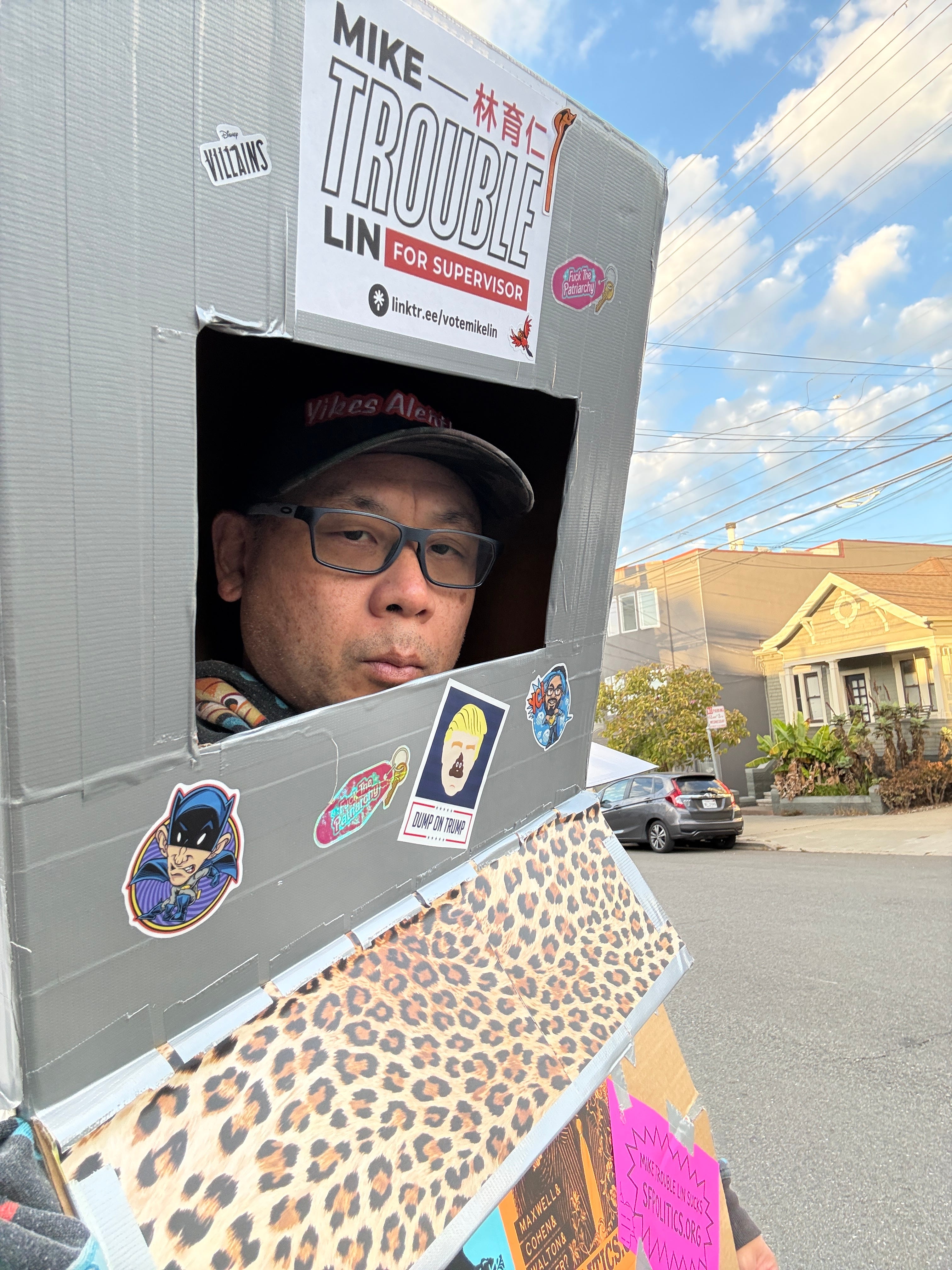
In Silicon Valley, founders brag endlessly about building a minimum viable product, finding product-market fit on a ramen budget, and disrupting legacy incumbents. In San Francisco politics, Mike Trouble Lin took that exact tech ethos, stripped out the venture capital, strapped on a cardboard box, and executed the leanest political campaign the city has ever seen.
Lin did not approach District 10 as an aspiring career legislator or an institutional insider. Instead, drawing on a career that spanned early tech design roles—including serving as LinkedIn’s second UI designer—and producing for the Vans Warped Tour, he treated the Board of Supervisors race like an agile startup experiment. His explicit framework was the classic hacker mantra: move fast, break things, iterate rapidly based on metrics, and refuse to be beholden to legacy gatekeepers.
While the frontrunner was backed by an $800,000-plus machine and the progressive favorites burned through six-figure budgets on direct mail and field consultants, Lin ran an entirely bootstrapped operation. His total reported expenses came out to just $397.
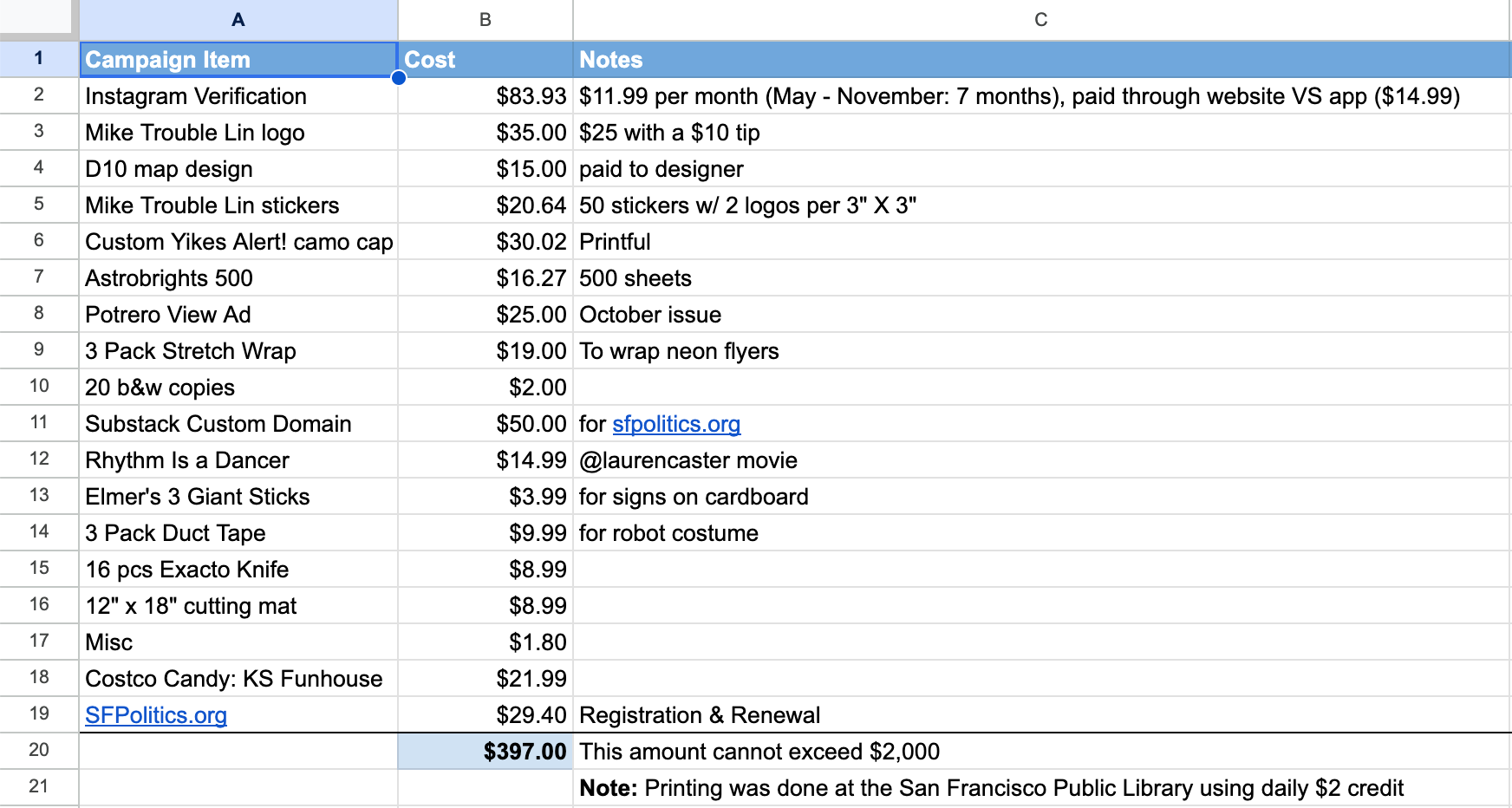
•https://docs.google.com/spreadsheets/d/1zRYfUB33R13TiOZAAWB7vTG6sv7v9BEPV2Qh2_Py8xc/edit?gid=0#gid=0
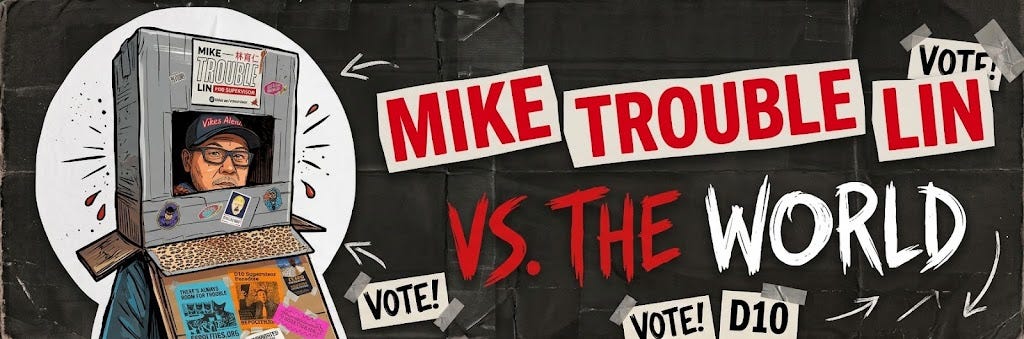
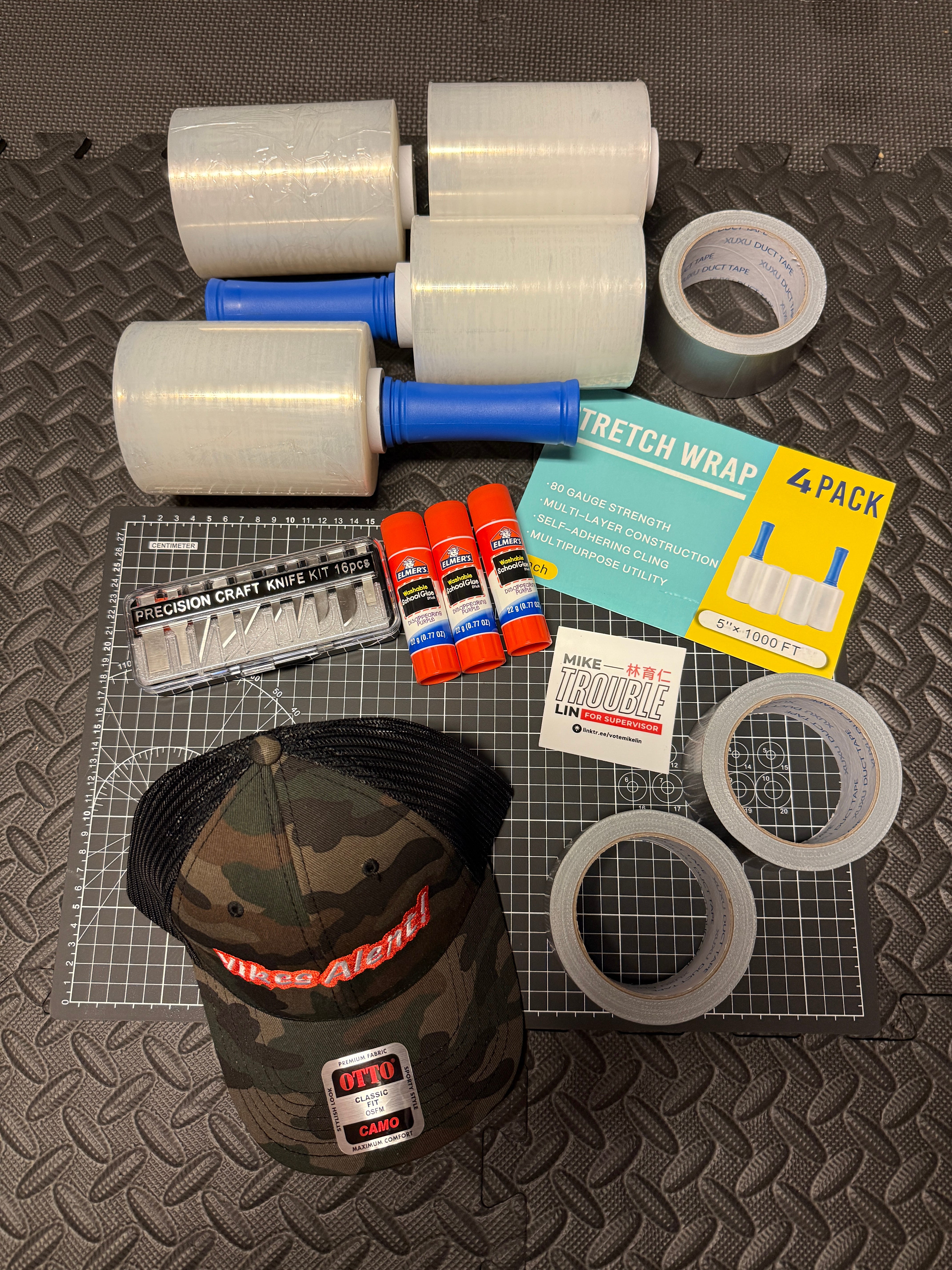
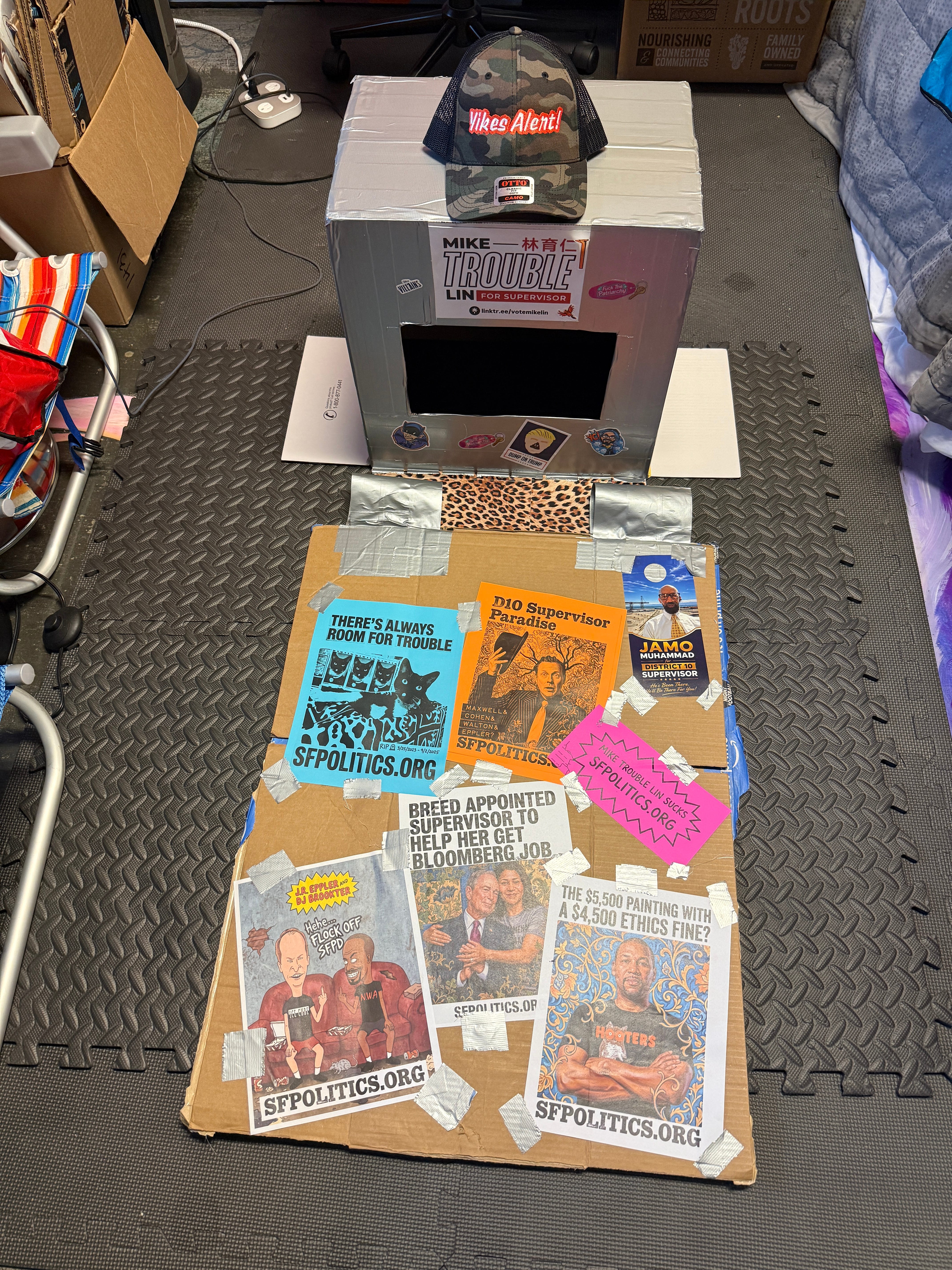
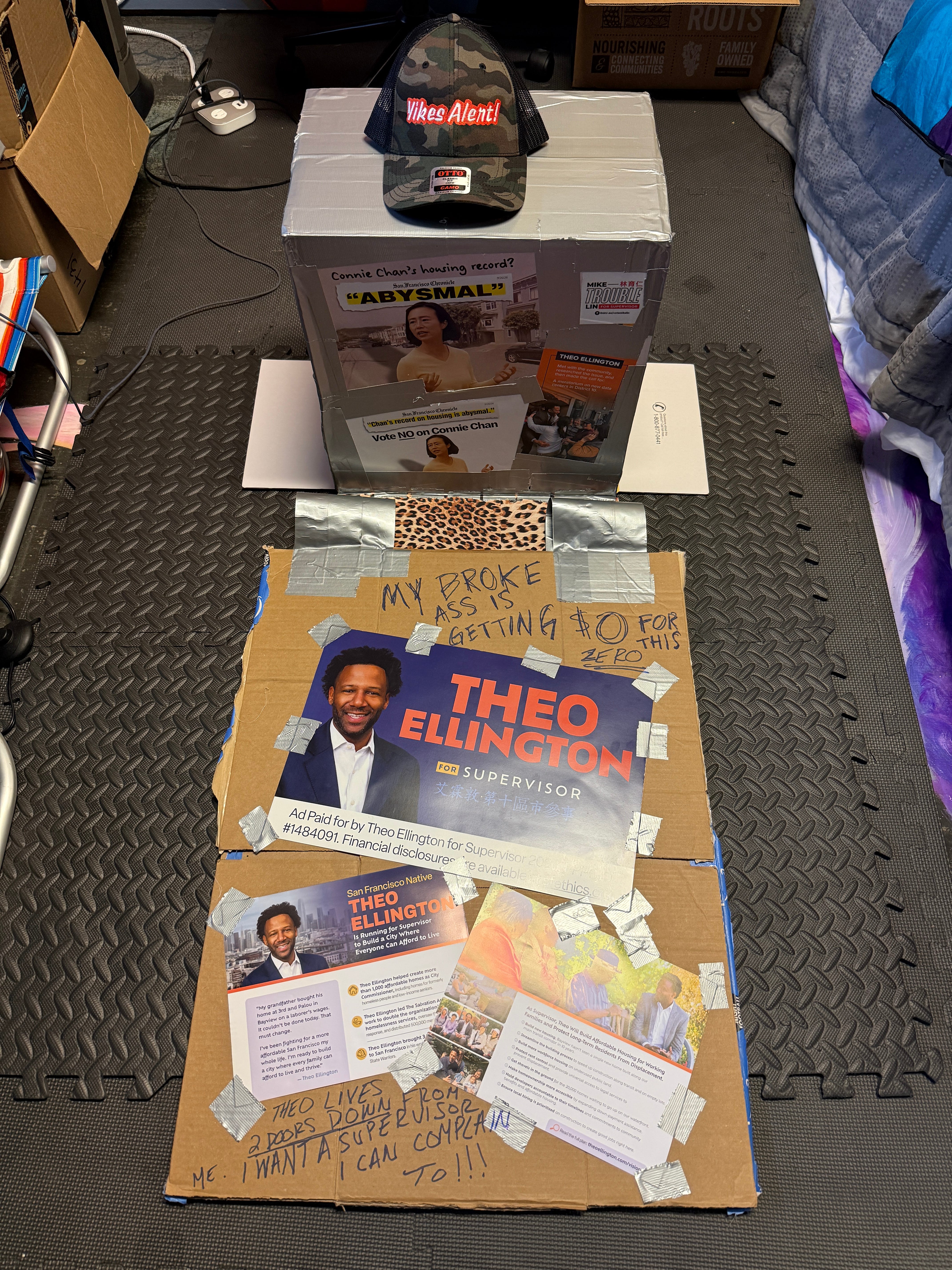
Where other campaigns spent thousands of dollars on branded lawn signs and glossy door-hangers, Lin engineered zero-cost, high-retention earned media. He crafted the “Trash Talk Bot”—a handmade wearable robot suit constructed out of duct tape, cardboard, and satirical neighborhood posters targeting local political controversies. He wore it directly on the streets, turning himself into an impossible-to-ignore physical installation. He secured a prominent profile in the Potrero View (“Here Comes Trouble”, reaching 12,000 households), ran watchdog commentary through his self-funded site at sfpolitics.org, and treated candidate forums not as formal debates, but as stages to challenge bureaucratic excess and call out City Hall spending.
Then came the ultimate growth-hack pivot: four days before the election, Lin formally announced he was suspending his candidacy, publishing an unapologetic manifesto warning voters that he belonged nowhere near City Hall and laying bare just how low the barrier to entry was for any determined provocateur.
The result was a masterclass in capital conversion: 541 first-round votes, surviving through five elimination rounds, and knocking out four fully active campaigns—all at a customer-acquisition cost of roughly 73 cents per vote. In a city where campaigns routinely spend hundreds of dollars per ballot, Lin proved that guerrilla marketing, sharp behavioral positioning, and raw startup hustle can still manufacture an authentic municipal footprint out of pocket change and a cardboard box.
The Evidence
Campaign Inspiration
I loved following Lauren Caster’s 30-day project and the film’s message that everybody needs to dance more!
I was inspired by all the Girl Scouts, especially Ara.
The unexpected plot twist inspired the final days of my campaign.
Thank you, Taylor Swift, for your music, which brought glimmers of hope during times of severe depression & suicidal ideation 🫶 as someone living with a clinical diagnosis of Bipolar 1 since the summer of 2015.
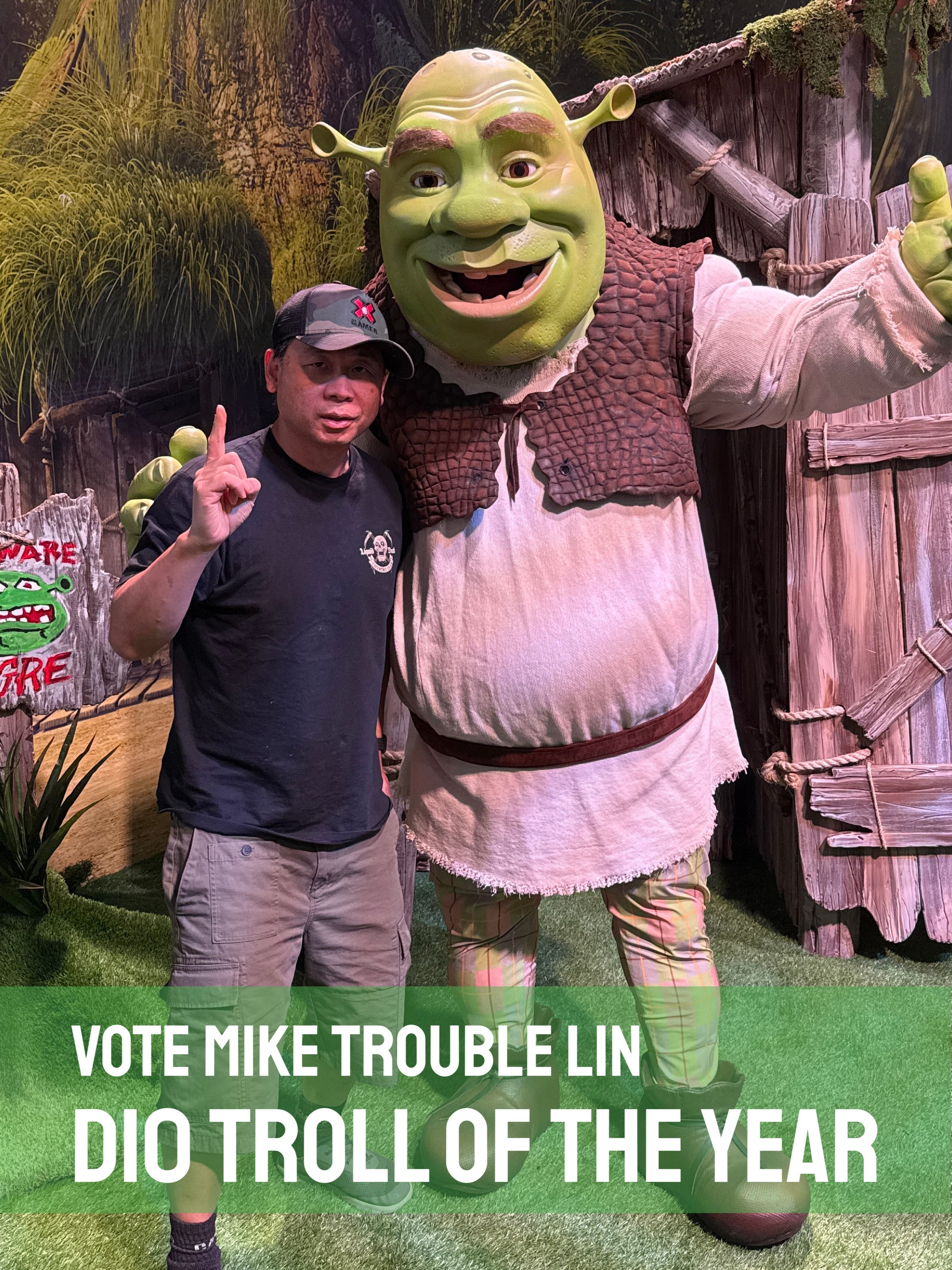
Vote Mike Trouble Lin D10 Troll of the year!
https://youtube.com/shorts/a4nQObgcAXM?si=SSrx_Fs7_9zxwmTo